PART 1
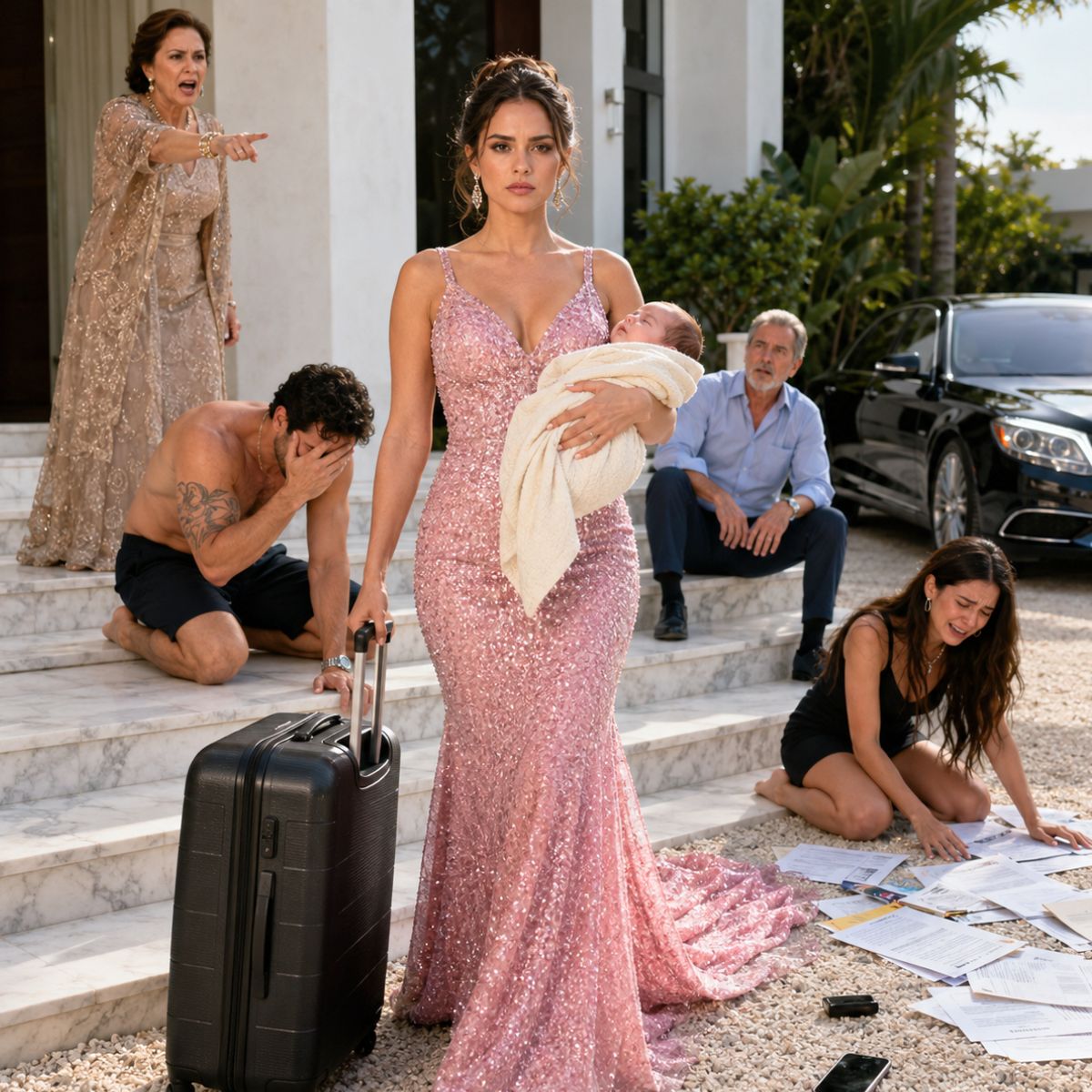
“I want a divorce,” Rafael told me at 4:30 in the morning while I held our two-month-old daughter against my chest and flipped chilaquiles for his entire family.
The kitchen smelled like green salsa, cinnamon coffee, and freshly warmed bread. I had been awake since 3 a.m. because the baby wouldn’t stop crying, and because my mother-in-law, Doña Elvira, had left a list taped to the refrigerator: eggs without chili for Don Arturo, chopped fruit for Aunt Carmen, handmade tortillas because “store-bought ones are for lazy people.”
I could barely keep my eyes open.
Rafael walked in quietly, wearing a wrinkled shirt, with stubble on his face and the sweet perfume scent that was never mine. He wasn’t coming home from work. No sane person comes back from an “urgent meeting” with glitter on his neck.
s, his silence.
But that morning, I didn’t cry.
I just adjusted Regina’s little blanket and asked:
“Was this so urgent that you had to tell me while I was cooking for your family?”
Rafael sighed, annoyed.
“Stop acting like the victim, Lucía. Ever since the baby was born, you’ve become unbearable. My mother is right: you’re not the woman I married anymore.”
I almost laughed.
Of course I wasn’t the same woman anymore. The woman he married still believed love meant enduring everything. The woman standing in front of him had already spent weeks sleeping with important documents hidden under the mattress.
I went to the bedroom. I pulled out a gray suitcase. I packed diapers, baby clothes, my documents, bank statements, a USB drive, and a yellow folder Rafael had never bothered to check because he thought it only contained recipes and pediatric papers.
He appeared at the door.
“What are you doing?”
“I’m leaving.”
He let out a dry laugh.
“Where are you going, Lucía? This house is mine. The car is in my name. I control the accounts. You have nothing.”
I looked at him with a calmness that surprised even me.
“That’s what they made you believe.”
I walked through the living room filled with silver-framed photos of his perfect family. In none of them did I look like a wife. I always looked like a guest, a maid, or an inconvenience.
When I opened the front door, the cold Puebla air hit my face. The city was still asleep, but for the first time in a long while, I felt awake.
I placed my daughter in the car seat and set the suitcase beside the diaper bag.
Rafael followed me outside, finally nervous.
“Lucía, don’t make a scene.”
That’s when I understood.
He wasn’t afraid of losing me.
He was afraid I would talk.
I drove away without looking back.
What he didn’t know was that I had saved receipts, transfers, audio recordings, messages, and proof of every peso my inheritance had contributed to building the house where they treated me like a servant.
And before the next Sunday morning arrived, his entire family would discover that the quiet woman they had looked down on hadn’t left empty-handed.
She had left with the truth in a folder.
And no one could imagine the explosion that was coming next…
What would you have done in Lucía’s place: stayed to fight in that house, or left quietly with the evidence?
PART 2
I drove to my Aunt Meche’s house on a quiet street near the market. She opened the door wearing a robe, her hair messy, still holding a rosary in her hand. She didn’t ask a single question when she saw me with the suitcase, the stroller, and those dry eyes from holding back tears for too long.
She only said:
“Come in, sweetheart. No one will throw you out here.”
That sentence broke something inside me.
In the Santillán house, everything was luxury, but there wasn’t a single corner where I could breathe in peace. Doña Elvira decided what we ate, how the baby dressed, when I could leave the house, and even which visitors were “appropriate.” Her daughter, Paola, used to say I looked “ruined” after giving birth. Rafael never defended me. On the contrary, he smiled as if those cruel comments were family jokes.
The worst part was the money.
When my father died, he left me a modest inheritance, but enough to start over. Rafael convinced me to invest it in remodeling the family house: a new kitchen, terrace, nursery, furniture. “Everything will be ours,” he used to say.
But the deed was never changed.
And whenever I asked about it, Doña Elvira would answer:
“A grateful woman doesn’t keep track of what she contributes.”
What they didn’t know was that before I got married, I worked in administration for a construction company. I knew how to read invoices. I knew how to spot inflated accounts. I knew when numbers were being manipulated.
And Rafael had far too many manipulated numbers.
My Aunt Meche took me to a lawyer named Patricia Ibarra, a woman with a calm voice and sharp eyes. Her office was downtown, above a stationery store, but the moment she saw my documents, she straightened up like she had just found gold.
“Lucía, this isn’t just a divorce,” she said. “There’s financial abuse here, possible fraud, and hidden assets.”
I felt a knot in my throat.
“I just want my daughter to be safe.”
“Then we’ll make sure the truth is stronger than their last name.”
The lawsuit was filed that same week.
Rafael started calling.
First he begged. Then he insulted me. After that, he sent messages saying his mother was sick because of me. I didn’t answer.
Then Doña Elvira showed up at my aunt’s house.
She looked impeccable, wearing sunglasses and carrying an expensive handbag. She walked in as if that place belonged to her too.
“You’re making a fool of yourself, Lucía. Family problems are handled at home.”
“Your son asked me for a divorce while I was making breakfast for all of you.”
She smiled with contempt.
“Men get tired. Smart wives learn how to keep their mouths shut.”
My aunt pressed her lips together but said nothing.
Doña Elvira stepped closer.
“If you keep this up, Rafael will ask for custody. What can you offer that little girl? A borrowed house? An ordinary last name? Regina is a Santillán.”
Hearing my daughter’s name in her mouth hurt.
Then she lowered her voice.
“And it would be wise for you to stop looking through papers. There are things an abandoned woman should never find.”
That’s when I realized this wasn’t just about money.
There was something hidden.
After she left, my aunt pulled out her phone from her pocket.
She had recorded everything.
Patricia requested a judicial audit.
The Santillán family responded immediately: they offered me an apartment, child support, a car, and silence. I said no.
At the first settlement hearing, Rafael arrived pale. He no longer looked like the mocking man from that early morning.
“Lucía, please,” he whispered when we were left alone for a minute. “You don’t know what you’re stirring up.”
“Then tell me.”
He glanced toward the door.
“My mother doesn’t forgive.”
Before I could answer, Patricia walked in carrying a new folder.
“We found a company called Inversiones Nopalera. There are transfers signed by Rafael, his father, and a woman named Brenda Salas.”
Brenda.
Paola’s “image coach.” The woman who was always at birthdays, baptisms, and family gatherings, standing far too close to my husband.
But what froze me wasn’t her name.
It was the date.
The transfers started two weeks before my wedding.
And on the last page there was something even worse: a life insurance policy in my name, modified after my daughter was born.
The beneficiary was no longer Regina.
It was Rafael.
What do you think that family was really hiding: just infidelity, or something much darker? The final part changes everything.
PART 3
The final hearing took place on a Thursday in family court, with the sun beating hard against the windows and my daughter asleep in my arms, unaware that her future was being decided there.
Rafael arrived in a dark suit with sunken eyes. Doña Elvira walked behind him, stiff, perfectly made up, proud even in the way she sat down. Don Arturo didn’t greet anyone. Paola pretended to scroll through her phone, but her fingers were trembling.
Brenda Salas didn’t appear.
But her name was all over the documents.
Patricia stood up slowly.
“Your Honor, my client was not simply abandoned. She was isolated, humiliated, stripped of resources, and pressured to remain in a family that used her money while making her feel incapable. Her inheritance was invested into a property that was never placed in her name. In addition, there are irregular transfers to a family company and a suspicious modification of a life insurance policy.”
The judge reviewed the documents.
Then Patricia played the recording of Doña Elvira.
“Smart wives learn how to keep their mouths shut…”
“Rafael is going to ask for custody…”
“There are things an abandoned woman should never find…”
For the first time, Doña Elvira lowered her eyes.
But the worst came next.
The audit revealed that Inversiones Nopalera was not a real business. It was a shell company used to hide money from the family accounts. Brenda had been receiving monthly payments since before my wedding. She wasn’t an image coach. She was Rafael’s mistress and also a hidden partner in the transactions the family used to drain accounts without leaving an obvious trace.
Rafael tried to claim he knew nothing.
Then Patricia showed the emails.
There was his name. His instructions. His cold words.
“It’s best to protect the assets before Lucía becomes unstable after childbirth.”
“Change the beneficiary as soon as possible.”
“My mother says she must not find out.”
I felt the ground shift beneath me.
Finding out about Brenda didn’t hurt me. I had already understood that long ago.
What hurt was knowing Rafael had used my exhaustion, my motherhood, and my silence to paint me as an unstable woman.
The judge was firm.
I was granted full physical custody of my daughter. Rafael would only have supervised visitation until he completed therapy and a psychological evaluation. The Santillán family was ordered to return the proven amount of my inheritance with interest and recognize my contribution to the increased value of the house. Authorities were also notified regarding the company’s financial activity.
When she heard that, Doña Elvira stood up furiously.
“You destroyed us!”
I looked at her without raising my voice.
“No, ma’am. I just stopped obeying.”
Rafael stayed seated, small and defeated, as if the last name he once bragged about was now too heavy to carry.
Months later, I rented a simple apartment with two bedrooms and a kitchen where the morning sunlight streamed in. The first time I made coffee there, I cried. Not out of fear. Out of relief.
There was no mother-in-law checking the salt anymore. No husband coming home smelling like another woman’s perfume. No family expecting me to serve the table while I was falling apart inside.
There was only my daughter laughing in her little chair, banging a spoon against the tray.
Over time, I started a small administrative consulting service for women who don’t know where to begin when they want to leave. Some arrive ashamed. Others arrive convinced they have nothing.
I always tell them the same thing:
“Before you believe you’re trapped, look carefully. Sometimes the cage is open, but you were taught never to look at the door.”
Rafael still sees Regina under supervision. Doña Elvira disappeared from the social events she once cared so much about. The Santillán family lost something bigger than money:
They lost the mask.
And I, the woman who used to cook at 4:30 in the morning with a baby in her arms, finally understood that divorce didn’t take away my home.
It gave me my life back.
Do you think Lucía was right not to accept money in exchange for silence, or would you have preferred to close the case and start over?